
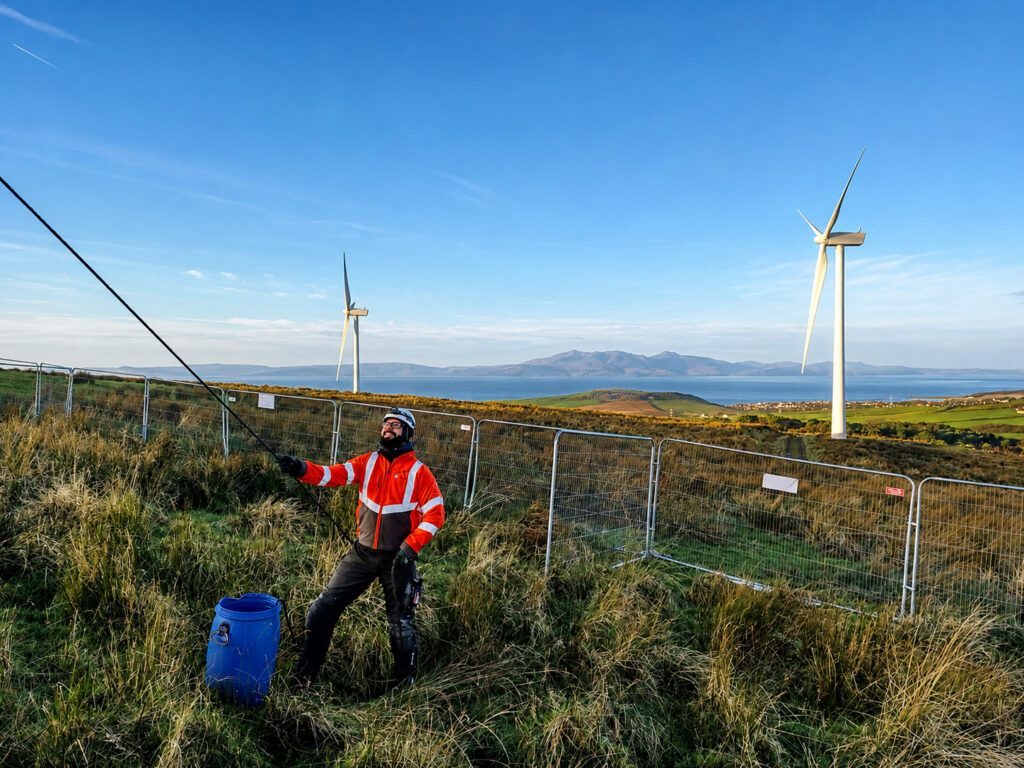

You’ve been part of the AIS Group for many years. Can you tell us about your career path?
I’ve been working in the wind industry since 2005, and my career has developed alongside the industry itself.
I started as a Wind Turbine Technician before progressing to Lead Technician and then Installation Supervisor. From there, my responsibilities expanded beyond turbine installation into lifting operations, where I worked as a Crane Supervisor and Appointed Person, planning and supervising lifting operations across wind projects in Europe.
That combination of turbine installation and heavy-lift experience became an important part of my career. It gave me the opportunity to understand both sides of the operation: what is happening on the turbine and what is required from the crane, lifting plan, logistics and wider site organisation to deliver a project safely and efficiently.
I later progressed into Site Manager and Senior Site Manager roles, taking responsibility for increasingly complex projects and often becoming involved where additional operational experience or problem-solving was required.
During those years I worked across different turbine platforms, projects and countries throughout Europe. That taught me early on that no two projects are exactly the same and that being able to adapt to different customers, technologies, teams and site conditions is essential in this industry.
That’s also where my working relationship with Andy McGlade, now Managing Director of AIS Wind Energy, really developed. Andy started as an electrician and progressed through site management, project management and business development. Our careers crossed many times over the years, and we worked closely together on numerous projects.
The real turning point came when ACH announced it was closing its wind division. I still remember Andy calling me afterwards and asking, “What are we going to do?”
My answer was simple: “What we know how to do best. We’re going to build turbines.”
That was really the beginning.
Andy initially focused heavily on securing funding and finding customers, while I concentrated on building the operational side: bringing together the right people, sourcing equipment and preparing projects for delivery. Costing and key commercial decisions were, and still are, something we work on together.
The AIS Group then came in to support what we were building. Matt Ainscough, CEO of Ainscough Industrial Services, and the wider organisation brought the financial strength, HR, payroll, commercial support and back-office infrastructure that allowed us to scale.
I became Operations Director of AIS Wind Energy in 2019, with Andy as Managing Director.
Looking back, I’ve gone from working hands-on as a technician to leading international operations, with experience across turbine installation, lifting operations, supervision and site management along the way. That practical background still has a major influence on how I approach the business today.
Q: As Operations Director, what were some of the key experiences or lessons that shaped your leadership style along the way?
A: Probably the biggest influence is that I’ve spent most of my career on the operational side of the industry, from working hands-on as a technician through installation and lifting operations to managing complete projects.
I know what it’s like to work rotations away from home, to deal with problems in real time and to be responsible for delivering a project when things aren’t going according to plan.
Operations can look very different on a spreadsheet from how they look at 7am on a wind farm.
Because of that, my leadership style is based heavily on trust and responsibility. I don’t believe in micromanaging capable people. I want people around me who can make decisions, solve problems and take ownership.
Flexibility is also extremely important. Wind projects are dynamic environments and circumstances can change very quickly. Plans are essential, but you also need people who can adapt when the plan changes without losing sight of safety, quality or the end result.
If you give someone responsibility, you also have to give them the authority and support to deliver.
I’ve learned that a strong business isn’t built by one or two people making every decision. It’s built by developing people you can trust to make the right decisions when you’re not there.
Q: Looking back on your career with AIS so far, what achievement are you most proud of?
A: Without question, it’s what Andy and I, together with the people around us, have built with AIS Wind Energy.
We started with experience, industry knowledge, a small group of people we trusted and a determination to make it work.
The early days were very different from the business people see today. Both Andy and I took additional work when necessary and used our own earnings to help support wages and keep things moving. At that stage, every project and every decision mattered.
One of our first major milestones was securing the Vestas project at Gweedore Wind Farm in 2019, installing three turbines. For a young company, it was an opportunity to prove that our team and the model we had created could deliver for a major turbine manufacturer.
The involvement of Matt Ainscough and the AIS Group was another important step. It gave us the financial and organisational platform needed to turn what we had started into a scalable business.
Today we have around 30 of our own people, before subcontractors and specialist partners are counted, supporting projects across several European markets. What started as a small turbine installation business has developed into an organisation combining experienced wind turbine teams with substantial crane and heavy-lift operations.
When I compare that with where we started, I’m incredibly proud of what we’ve built together.
The scale has changed significantly. The mentality hasn’t.

Q: Are there any recent or upcoming projects that you’re particularly excited about?
A: What excites me most at the moment is the evolution of the business rather than one individual project.
Today, AIS Wind Energy is built around two major areas: our wind turbine services and our crane and heavy-lift operations. Crane operations represent a large part of our business and are absolutely central to what we do.
On the turbine side, we’ve developed from primarily supporting installation into a much broader operation covering supervision, QA/QC, statutory inspections, scheduled maintenance, finishing and specialist services.
Alongside that, our crane teams support wind projects with major lifting operations, including turbine installation and major component work. Having that capability within the wider AIS operation gives us a much broader understanding of the complete project and allows us to coordinate lifting and turbine activities much more effectively.
We’re also becoming increasingly international, with operations across the UK, Ireland, Germany, Benelux and Scandinavia.
What excites me is bringing those capabilities together.
Rather than being viewed simply as a labour supplier or a crane supplier, we are taking responsibility for increasingly complex scopes and provide customers with an integrated and flexible solution.
Q: What do you believe truly sets AIS apart from other wind turbine installation and maintenance providers?
A: One of our biggest strengths is the combination of experienced wind turbine teams and significant crane and heavy-lift capability.
There are companies that specialise in supplying turbine technicians, and there are companies that specialise in cranes. We understand both sides of the operation.
That’s important because lifting operations and turbine installation are completely interconnected. The crane team, installation team, supervision, logistics and project management all have to work together. When those interfaces aren’t managed properly, that’s where delays, additional costs and operational problems can develop.
I also believe one of our real strengths is our flexibility and ability to adapt.
Wind projects rarely go exactly according to plan. Weather changes, schedules move, components are delayed, site priorities change and customers sometimes need resources redirected at short notice. You have to be able to react quickly without compromising safety or quality.
Being relatively agile, while having the resources and support of the wider AIS Group behind us, gives us a strong combination. We can make decisions quickly, adapt our resources and find practical solutions when circumstances change.
Ultimately, though, I want AIS Wind Energy to differentiate itself through reliability and quality.
I don’t want us to be known simply as the biggest or the cheapest supplier. I want us to continue to be known as the supplier you can rely on to adapt, find a solution and do the job properly.
Q: Building and maintaining a strong team is critical. What do you look for in people, and how do you create a culture where teams can thrive and perform at their best?
A: Technical competence is important, but attitude and reliability matter just as much.
Skills can be developed. It’s much harder to teach someone to take responsibility, support the people around them and remain dependable when things become difficult.
I value people who see a problem and immediately start thinking about the solution rather than why it belongs to somebody else.
Development is equally important. Many of the strongest people in this industry started at technician level, myself included. If someone demonstrates the ability and attitude to progress, they should be given the opportunity to do it.
The aim is to build teams where people understand what is expected of them, trust each other and are confident enough to make decisions.
As we’ve grown, this has become even more important. Whether someone is working in a turbine team, crane operations, project management or the back office, they need to understand that they’re part of the same operation and working towards the same result.
Q: Across the AIS Group, safety is at the core of everything we do. As Operations Director, how do you ensure that a strong safety culture is embedded across every project, team and decision made?
A: Safety has to be part of everyday operational decision-making, not something that exists separately in procedures or presentations.
The real test comes when there is pressure: a project is behind schedule, a weather window is closing or a turbine needs to be completed.
That’s when people need to be confident enough to stop and challenge something if it isn’t right.
This is particularly important in our business because we’re working with heavy lifting, large components, complex installation activities and teams operating in demanding environments. There is very little room for complacency.
Training, competencies, equipment and procedures provide the framework, but management behaviour creates the culture. If we tell people safety comes first, we have to support them when they make a legitimate decision to stop work.
No milestone or deadline is more important than making sure everyone goes home safely.
Q: Trust is fundamental when working with major asset owners and developers. How do you work to build and maintain long-term relationships with clients?
A: Trust comes from consistency, transparency and delivery.
It’s easy to have a good relationship when everything is going according to plan. The strength of the relationship becomes much clearer when there is a problem or when a customer suddenly needs you to adapt.
If something isn’t right, I’d rather tell the customer early, explain the situation clearly and work with them on the solution than try to make the problem look smaller than it is.
At the same time, we try to understand the pressures our customers are dealing with. Their priorities and schedules can change quickly, and where possible we need to be flexible enough to change with them.
Consistency is equally important. Flexibility doesn’t mean lowering standards. Customers need to know that however the project changes, the same expectations around safety, quality and delivery remain.
We are not a manpower provider, a crane provider or another subcontractor. We act as a trusted partner, understanding what the customer is trying to achieve and helping them to deliver it.
That’s how supplier relationships develop into genuine long-term partnerships.
Q:The wind energy sector continues to evolve rapidly. What trends are you currently seeing in the industry, and how is AIS Wind Energy ready to support the next generation of wind energy projects?
A: The industry is becoming more technically demanding, and that’s particularly visible in lifting operations.
Turbines are becoming larger, components are becoming heavier and hub heights are increasing. That changes not only the technical requirements of the turbines themselves, but also the cranes, lifting configurations, logistics, planning and specialist expertise required to build and maintain them.
At the same time, Europe has a substantial installed fleet that is ageing. That creates another major requirement for cranes and specialist teams through gearbox, generator, blade and other major component replacements, as well as life-extension work, repowering and eventually decommissioning.
For us, that’s particularly important because we’re positioned on both sides of that market.
We have experienced turbine teams who understand the equipment they’re working on, and we have crane and heavy-lift expertise capable of supporting the lifting operations around those assets.
That means we’re not looking at the future of wind purely in terms of new turbine installation. We see opportunities throughout the complete lifecycle of the asset, from construction through maintenance and major component replacement to repowering and decommissioning.
Q: From your perspective, where do you see AIS Wind Energy heading over the next five to ten years?
A: I want AIS Wind Energy to continue growing, but growth alone isn’t how I would measure success.
My ambition is for us to become recognised as one of the most reliable and highest-quality wind energy suppliers in Europe, with both turbine services and crane operations at the core of that offering.
I see significant potential in continuing to develop the relationship between those two sides of the business.
The more capability we have in-house, from technicians and supervisors through project management and specialist services to cranes and heavy lifting, the greater the scope of work we can take responsibility for.
For customers, that means fewer interfaces to manage, greater flexibility when project requirements change and one organisation taking greater ownership of delivery.
As turbines continue to grow and the existing European fleet gets older, I believe that combination of turbine expertise, lifting capability and operational flexibility will become even more valuable.
I don’t necessarily want AIS Wind Energy to be the biggest company in the market. I want us to be one of the best.
If a customer has a technically difficult project, a challenging lifting operation or simply needs certainty that the job will be delivered to the right standard, I want AIS Wind Energy to be one of the first companies they think of.
We’ve already come a long way from where we started, but I don’t think we’ve reached anything close to our full potential yet


